Badge of Honour
On moving to Ahmedabad at five with an American accent, slowly losing it, never quite losing it, and turning out to be a little too good at sounding like wherever I happen to be.
A couple of weeks ago I went to a Halloween party dressed as Simon from Alvin and the Chipmunks (Nil was Theodore, Krithin was Alvin, and yes, I was the one with the glasses).1 Somewhere in the middle of the night, a friend of mine was telling me about something completely unrelated when she stopped, kind of mid-sentence, and told me she’d only just found out I was a FOB.2
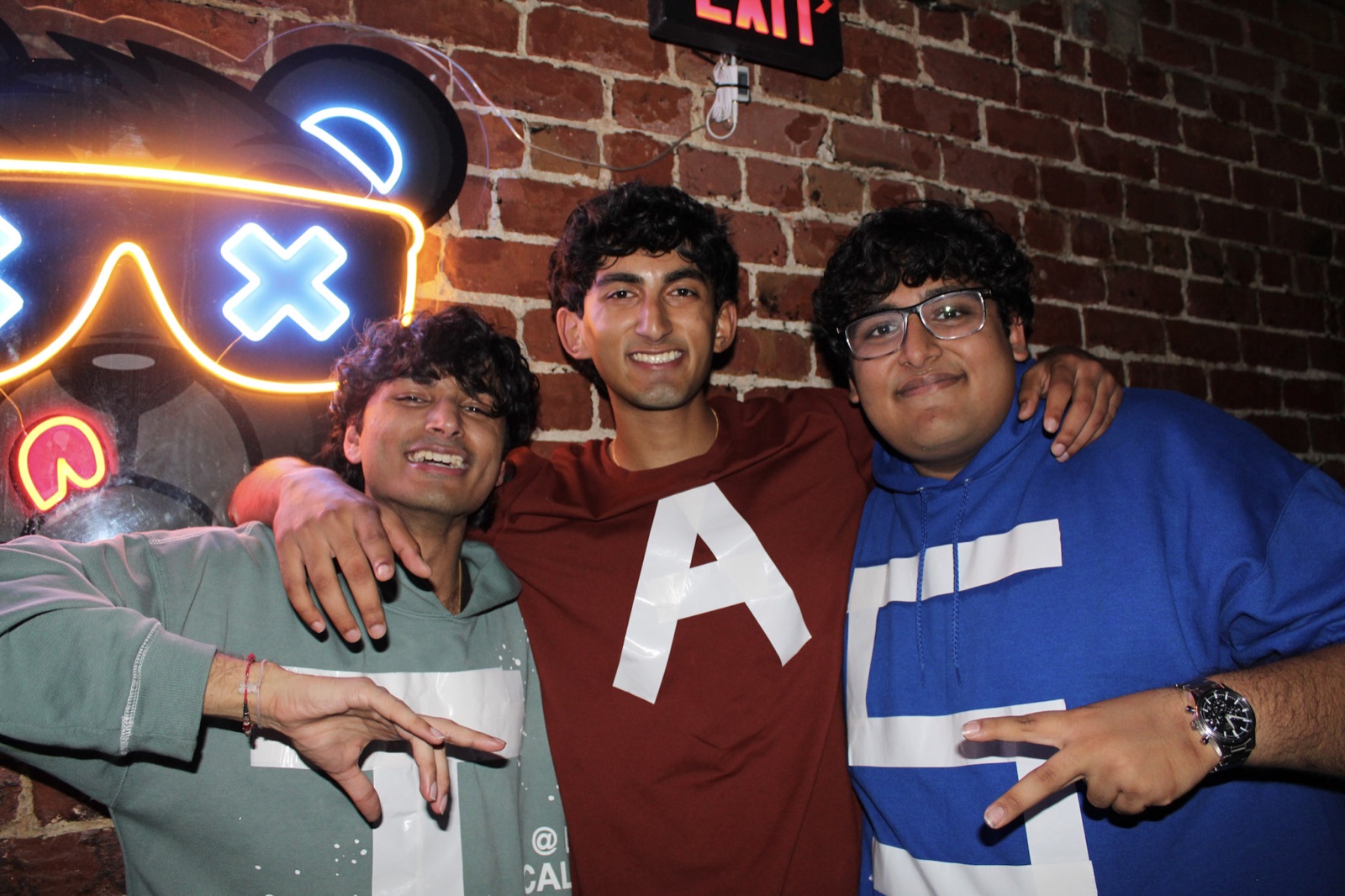
Theodore, Alvin, and Simon, left to right, or Nil, Krithin, and me. The costumes are just tape letters stuck onto our clothes, which I maintain counts.
She didn’t mean anything bad by it. If anything she sounded kind of delighted, like she’d just found out I could juggle or something. And then she asked the question that always, always comes next: wait, so how come you don’t sound Indian?
I’ve had this conversation so many times at this point that I could probably have it in my sleep. In dorm hallways, before lecture (on the rare occasion that I actually go to class, that is), at dinners where somebody asks where I’m from and I say Ahmedabad and they do a little double take. And I always give the same answer, which is that I’m just really good at sounding American. Everyone laughs, and we move on to something else.
But I’ve been thinking about that answer a lot since the party, and I don’t think it really answers anything. So this is me trying to come up with a better one.
I was born in the US, and when I was five my family moved to Ahmedabad. I spoke English and Gujarati, but no Hindi at all3 (which, in a Gujarati city, you’d think wouldn’t matter that much; it mattered a lot), and I had this thick American accent that pretty much nobody around me could understand.

My first ever day of school in India, at the first school (not the international one), looking a lot more confident than the situation called for.
I lasted about a month at my first school. After that my parents moved me to an international school4, where a kid with a nontraditional accent like mine would be at least a little more accepted. I picked up Hindi really quickly, mostly from other kids, the way you do when you’re five and every game on the playground is being played in a language you don’t know yet.
The accent took a lot longer to go. Mostly because, for a long time, I didn’t want it to.
For years, I wore my American accent like a badge of honour.
I started debating in eighth grade and (I’m going to brag for exactly one sentence here) I was pretty good at it; I made it to the ISDS national camp in my very first year competing. And whenever I spoke in front of people, whether it was a debate round or an assembly or one of the million other speeches that Indian schools find a reason to make you give, I’d turn the accent all the way up. Not my normal accent, which by that point was already starting to fade, but this exaggerated, honestly kind of ridiculous version of it, with every t turned into a d and every vowel dragged out for way longer than it needed to be. And I loved it. In a school where everybody sounded more or less the same, it was the one thing I had that nobody else did, and I made very sure that everyone knew it.

I couldn’t find a single photo of me debating, so here’s me at a different high school event instead, playing a lawyer. I look very angry, very loud, and very low-resolution.
Then one day a kid a couple of years younger than me found out I spoke Hindi, and he was shocked.
Not in a mean way. He was just confused, because he’d only ever heard me give speeches, and from that he’d figured I must have just moved here from the US. I’d been living in Ahmedabad for nine years at that point. I’d been speaking Hindi for almost all of them.
That one stuck with me for a while. I’d always thought the accent made me stand out, and it did, but I hadn’t realized that it also made me seem kind of unapproachable, and a little pretentious, even, which was a strange thing to realize (nobody ever actually said it to me; I figured it out on my own, which was somehow worse) because the accent really was mine. I was born in America! I wasn’t faking anything. But I’d turned it into this whole performance, and for a lot of people at that school, the performance was all they ever saw of me.
So I softened it. Though not all at once.
There was never really one moment, or one decision. I never sat down and practised sounding Indian. It just sort of happened over the years, a little at a time, until at some point it was simply how I talked. By the time I ran for Head Boy5, I gave my election speech in an Indian accent, and every speech after that, too. I’d like to think that’s not why I won. I’d also like to think it’s not not why I won.
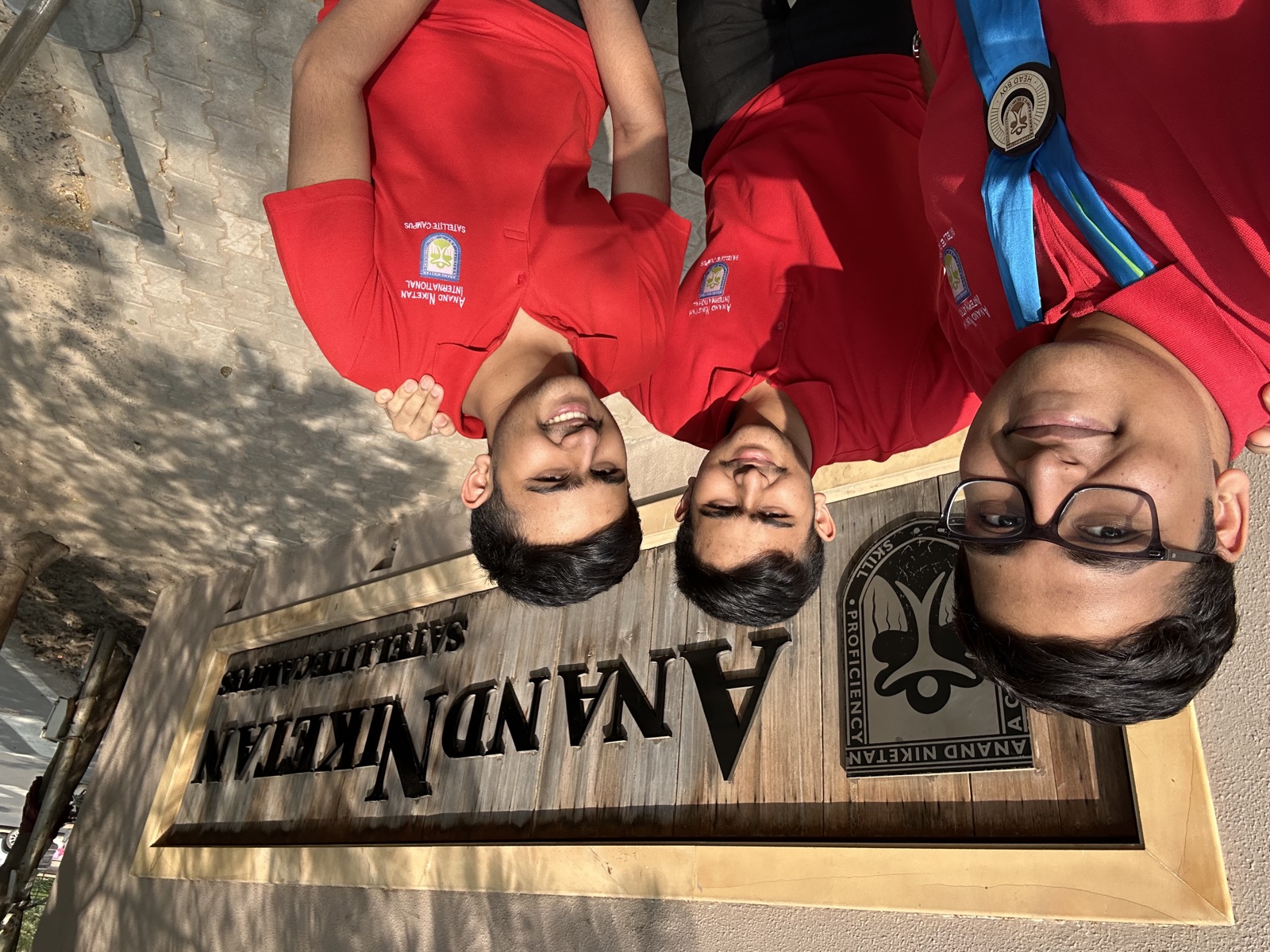
The Head Boy badge, on the last day I ever spent on that campus (the school moved to a new one in my senior year), with Aahan and Aayan. Also, note the hair. That changed when I moved back too.
Something I didn’t know until I started writing this: linguists have been studying exactly this since 1973, when a social psychologist named Howard Giles noticed that people being interviewed tend to start sounding like whoever is interviewing them, without meaning to.6 The theory that came out of it is called communication accommodation theory (catchy, I know), and the basic idea is that we’re all constantly adjusting the way we talk depending on who we’re talking to. If we want to fit in with somebody, we converge, and drift toward the way they talk. If we want to stand apart from them, we diverge, and lean harder into whatever makes us different.
Reading that for the first time was honestly a little embarrassing, because I’d done both. In that order. At the same school. The over-the-top American accent at debate was me diverging about as hard as a person can diverge, and the slow slide into an Indian accent afterwards was me converging. I’d spent years thinking of this as some very specific, very personal thing about me, and the whole time there was an entire field of research that could have just told me what I was doing.
Age matters too. From what I’ve read, the younger you are when you move somewhere, the more likely you are to end up sounding like you’re actually from there, and that gets a lot harder once you’re a teenager. I moved at five, so I never really learned an Indian accent; I just absorbed it, the same way I absorbed Hindi. And the accent I absorbed didn’t replace the American one. They both just stuck around. I never lost the ability to sound American. I just didn’t use it for about a decade.
And then, a little before I turned 18, I moved back.
It took maybe a semester for everything to flip again (and, again, nobody asked me). I sound American now. Not the exaggerated debate version, just regular American, pretty much the way I sounded when I was five. And because of that (or maybe it’s the other way around, I honestly can’t tell) almost all of my friends at Berkeley are from here. Which isn’t a bad thing! I love my friends, and they’re a huge part of why Berkeley feels like somewhere I actually live. But it does mean I’m not really part of the international community here, the students who moved from India for college at the same time I did, and who mostly still sound like it.
Nil and Krithin (pictured in an earlier post) are both from the US, and both of them have told me they had no idea I grew up in India until I told them. Which is pretty funny, because Nil, who was born and raised here, speaks Gujarati with an accent so rural that he sounds like he’s straight out of a village.7 So between the two of us, the guy who grew up in Ahmedabad sounds like California, and the guy who grew up in California sounds like he’s never left the village. Neither of us did this on purpose.
My Indian voice is still there, obviously. My family hears it, and so do all my friends from India. I don’t notice when I switch, but everyone around me does.
And sometimes, at a party or wherever, I’ll do the Indian accent as a joke, and people will laugh, but then I can tell from the way they’re laughing that they think it’s an impression. Like it’s fake, and I’m just putting it on.
Which is, I think, the entire thing at discussion here, summed up neatly. Back in India, I took my real American accent and turned it into a performance. Here, my real Indian accent gets treated like one. It’s the same me, and both of those accents are mine, but every room I walk into seems to decide for itself which one is real and which one is the act.
I always used to describe all of this as code-switching, and while I was writing this I found out that the term originally meant something a lot more specific. The classic study is from 1972: two linguists, Jan-Petter Blom and John Gumperz, spent time in a small town in northern Norway called Hemnesberget, where people went back and forth between their local dialect and standard Norwegian.8 They split switching into two kinds. Situational switching is when the situation changes and the way you talk changes with it, like how my voice changes the second I pick up a call from home. Metaphorical switching is when nothing about the situation changes, but you switch anyway, on purpose, to make a point (or a joke).
So technically, doing the Indian accent at a party is metaphorical switching. I’m borrowing a voice to be funny. The voice just happens to be mine.
These days people mostly use “code-switching” to mean something bigger: the way you change how you talk and act and what you share depending on who you’re with. And that’s the version I’ve been doing my whole life, really. I’ve always tried to fit in with whoever’s around me, and I think I might be too good at it. Because if you keep fitting in with wherever you are, eventually you look up and realize you’ve drifted pretty far from where you started.
When I left for Berkeley, my parents moved to LA. My brother and my grandparents are there too, so these days, when I fly home, I fly to LA. And it is home, kind of. Everyone I’d call family is there. But I’ve also had home home, which was one house in Ahmedabad that I lived in for thirteen years, and I don’t fly there anymore.
I think that’s why this bugs me more than a random comment at a Halloween party probably should. Nobody is making me sound American. Nobody has ever asked me to. It just happens, the same way the Indian accent happened, a little more every month, and the easier it gets, the more it feels like I’m drifting away from who I am and where I’m from. And where I’m from is India. It has been since I was five, whatever my passport says.
The funny thing is that the one voice nobody ever hears is the one I think in.
I don’t think in English, and I don’t think I ever have. I think in this mix of Gujarati and English that switches back and forth mid-sentence (sometimes mid-word) with no real rules, and it’s the only version of me that’s never had to fit in with anyone, because nobody else is in there. When I talk now, it comes out as a weird mix of both accents too, which I can’t really describe and other people can’t really place. And when I write, I still spell colour and favourite and honour the way I learned to in school.9
So the next time someone at a party asks me why I don’t sound Indian, I’ll probably still say that I’m just really good at sounding American. It’s not wrong. I’m just not so sure anymore that it’s a good thing.
-
Simon is the tall one with the glasses who is, canonically, the smart one, which I’d like to think is why I got the part (and not my eyesight). Fun fact I learned way too late: all three Chipmunk voices are actually one guy, Ross Bagdasarian, singing slowly into a tape machine running at half speed and then playing it back at normal speed, which is what makes them squeaky. According to his family, he spent $190 of the last $200 he had in the bank on that tape machine. I didn’t know any of this at the party, which is probably for the best, because nobody wants to hear Simon explain tape speeds at 1 AM. ↩
-
“Fresh off the boat.” It’s slang for a recent immigrant, and depending on who’s saying it, it can be anything from affectionate to pretty mean (it’s also the title of Eddie Huang’s memoir, and the sitcom that was based on it). For the record, I flew. There was no boat. ↩
-
Gujarati is what Ahmedabad speaks at home, and what my family spoke to me. But Hindi is what the rest of the country speaks to itself: in movies, in cricket commentary, and, most importantly for a five-year-old, on the playground. ↩
-
The other reason (and honestly, probably the bigger one) was that Aahan and Aayan were already there. The three of us were born in the same hospital in the US, our families were friends before any of us could talk, and they’d made the move to India too. So I followed them to that school, and they’ve been two of my best friends for my entire life. They’re at IIT Kharagpur now. Out of the three of us who started out in that one hospital, I’m the only one who moved back. ↩
-
For American readers: Head Boy is basically student body president, except with a lot more standing at the front of morning assemblies and a lot less actual power over anything. ↩
-
The 1973 paper was about what Giles called “accent mobility,” and the starting observation is about as simple as social science gets: people being interviewed shift their accents toward the interviewer’s. It was first called speech accommodation theory, and then, once it grew to cover things like gestures and pace and word choice, communication accommodation theory. Linguists love giving an obvious thing a long name and then giving it a longer one. ↩
-
I say this with love. It is also completely true. This guy says “hu h” instead of “su chhe”. He’s crazy. ↩
-
The locals spoke a regional dialect called Ranamål with each other and switched toward standard Norwegian for school, official business, and outsiders. The original paper is called “Social Meaning in Linguistic Structure: Code-Switching in Norway,” and it’s a surprisingly good read for an academic paper about Norwegian dialects. ↩
-
I took Cambridge (CAIE) exams all through school, and the textbooks spelled everything the British way. I spell -ize the American way, though, so what I’ve actually been doing all along, with -our and -ize together, is technically called Oxford spelling. Which might be the most Cambridge-educated thing a person could possibly do by accident. ↩