Names on a Page
On a decade of characters who lived on a bicycle, the lockdown that ended them, and why the only public evidence of me as a writer is the thing that cost me the rest.
I’ve always had a sort of love-hate relationship with writing.
If one were to explore the halls of my iPhone’s Notes app, they would (among all the grocery lists, In-N-Out orders and linear algebra notes) find years and years of my reflections and opinions, a trove of poems and essays so expansive that it would put some (tiny) libraries to shame, written but never shared anywhere or with anyone. After all, as Google so helpfully loves to remind me (complete with mildly embarrassing pictures of pre-teen me, pulled from the old Facebook page my mom used to run) whenever I search up my own name, I am an author! Not a best-selling one, far from a good one, but an author indeed.
My journey to becoming a so-called author has been an interesting one. Despite being probably the most frequent visitor of my school’s library growing up in elementary school, I never really started writing down my own stories until a few years later. That isn’t the confession it sounds like, though. It isn’t that there weren’t any stories. If you could have walked the halls of my head at ten years old the way I’ve just invited you to walk the halls of my Notes app, you’d have found the place considerably more crowded than it is now (and, a little embarrassingly, considerably better organized).
It started with action figures. I was a pretty big fan of Hasbro’s Transformers line of toys growing up (my favorite Transformer being Optimus Prime, of whom I had probably a half dozen different toy figurines) – and as I played with my toys as a young child, I very quickly stopped caring about who the box said they were. Optimus Prime is, officially and canonically, the noble and self-sacrificing leader of the Autobots.1 In my bedroom he was whatever that particular afternoon required, which was frequently a villain, occasionally somebody’s father, and at least once, for reasons that are now lost to history, a shopkeeper. Nobody from Hasbro ever came to correct me. Eventually I outgrew the figurines themselves (or at least outgrew being seen with them) but I never outgrew the part where you take somebody else’s character and quietly make him yours. That just moved somewhere it couldn’t be confiscated.
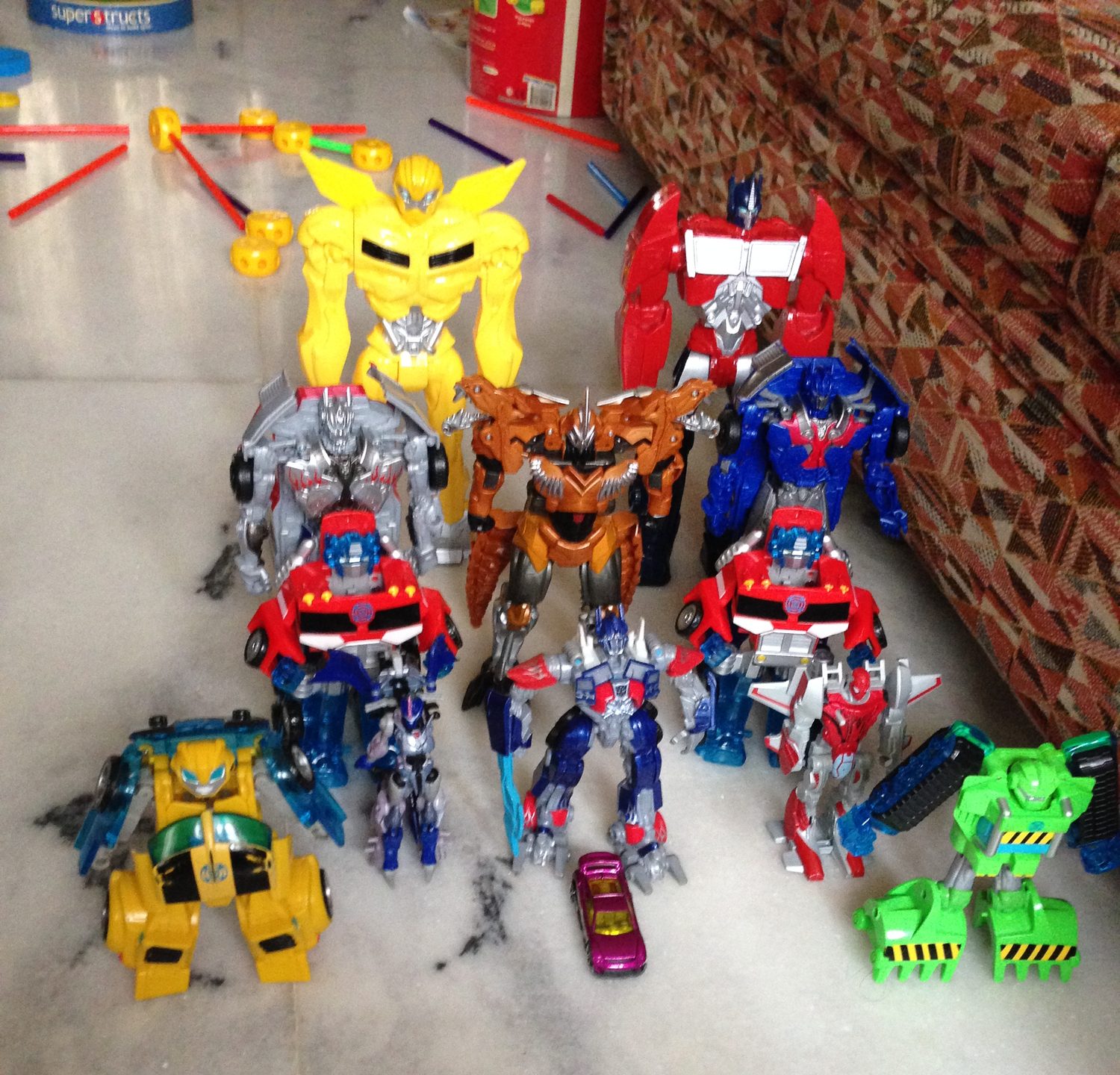
Part of the roster, photographed by me, aged seven. Note that they are arranged rather than dumped in a pile — I had lined them up for something. I count at least four Optimus Primes in this picture alone.
The premise was pretty simple. I really liked to bicycle (something about the wind rushing past and the nice repetitive yet never-boring motion of pedaling greatly appealed to my senses), but my parents didn’t trust me to ride my little orange bicycle out in the streets of Ahmedabad (probably for the best – Indian traffic is no joke as a young cyclist, and I was always the kind of kid that had his head in the clouds more than he did on the road). So, I was confined to riding endlessly in loops around the main street of the small, U-shaped society I lived in2 – the same two hundred meters, over and over, from one end to the other and then back again, so many times that the guard at the gate would eventually stop bothering to look up at me when I passed him ringing my obnoxious little bell. On paper, it is one of the most boring ways a child can possibly spend an afternoon. It was also the most productive creative environment I have ever had access to, and I have not found anything since that comes particularly close.
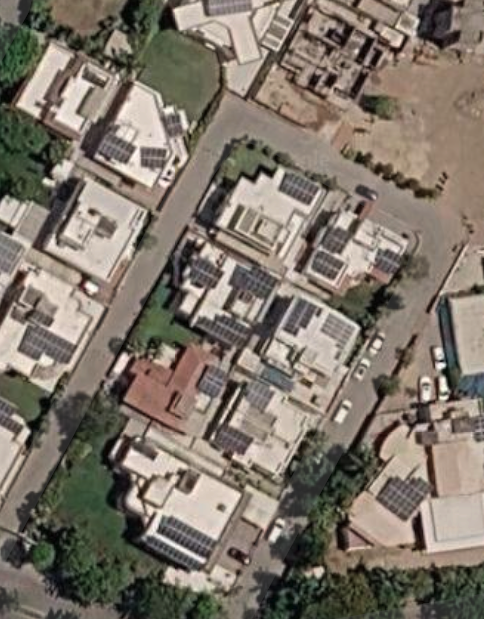
The entire world, as of about 2016. Two hundred meters from one end to the other and back again, several thousand times. The satellite has no idea what was going on down there.
Because somewhere in the third or fourth hour of going nowhere, I started making things up again.
The first of them was a wise, all-powerful warrior named EveryOne.3 He had colorful magic, which is genuinely as far as the specification went, and which I considered at the time to be completely airtight. Then EveryOne had company, and the company had names, and the names had ever-evolving dynamics and histories, and by the time I was eleven there was an entire population in there.
Most of these characters of mine were stolen. I’d take characters out of whatever I was reading that month – and I read constantly, so there was a lot to go off of. I’d keep their names, and then rebuild them from the ground up into people their original authors would not have recognized. You know, same license plate but an entirely different car. Percy Jackson was my protagonist for something like two years without ever doing a single thing Rick Riordan actually wrote him doing.4
And because none of it was written down anywhere, none of it had to hold still. A character could be one thing in March and something else entirely by June, and there was no earlier draft to answer to, because there were no drafts to begin with. If I decided that Percy had always been afraid of the water, then he always had been, retroactively, all the way back to the beginning. Simple as that. The world these characters lived in worked the same way. I had two halves of it, the Golden Side and the Silver Side, and for years they existed as a sort of atmospheric pressure rather than a fully fleshed out system, in the sense that I knew exactly what they felt like, I could not have told you how they worked, and (probably most crucially) nobody ever asked me. It was my universe, I was answerable to no one, and boy did I enjoy playing God over my creations.
Then, sometime near the beginning of eighth grade, the COVID-19 pandemic hit.
I don’t think I need to describe 2020 to anybody who was there for it. What matters for this story is one very small and very specific consequence of it, which is that the street went away. India’s lockdown was not what you would call a gentle suggestion,5 and my loop was abruptly off limits along with everything else in the world. The orange bicycle went into a corner of the parking area and stayed there.
And I want to be precise about this next part, because it took me the better part of a decade to notice it: the loop was not where I thought about my characters. The loop was how I thought about them. The pedaling was the engine. Whatever it is that happens inside your skull during the third consecutive hour of a repetitive physical motion – that was the thing manufacturing all of it, every day, for free, and I had never once had to think about it, because I was eleven and the street had always simply been there.
What I had instead now was a laptop, a closed door, and more uninterrupted time than I have ever had before or since.
So I had what still strikes me as the single most reasonable idea of my entire life. I had all of these characters. I had all of this world. I now had, quite suddenly, absolutely nothing else to do with either of them. Wouldn’t it be cool if I put them in a book?
So I did.
I changed Percy’s name to Aiden. I took the Golden Side and the Silver Side and finally sat down and worked out how they actually functioned – what the limits were, what it cost to use them, why a person couldn’t simply do whatever they felt like. I wrote the rules down. I took a decade of half-formed, self-contradicting, constantly-revised material and gave it a fixed shape, which is, as far as I can tell, the entire job description of an author.
It took months. It worked. There is a book.6 It was 200 pages long. My mom put it on Facebook. Google, as previously established, has never once let me forget it.
I started the second book about a year later, and I want to be clear that nothing about my circumstances had gotten worse. I was older. I was a measurably, obviously better writer. I still had far more free time than I will ever have again. And I had a finished first book to build on, which is the part that everybody tells you is supposed to be hard.
I could not do it.
Not in the way people mean when they say writer’s block, either. I could produce pages, and the pages were fine – I don’t think a reader could have pointed at where the problem was. What I couldn’t do was the thing I had done for free, for hours a day, for years, on a bicycle, without ever once considering it work: I couldn’t get them to move on their own.
Before, I would put a character into a situation and they would respond. Now I would put a character into a situation and have to go look up who they were. Because there was a canon now.7 Chapter four had said something. Aiden had a documented reason for the thing he did in the second act, and that reason existed on a page, in print, in a book with an ISBN, and it was not going to quietly change its mind in June the way it used to. The Silver Side worked one specific way, which meant that it had stopped working every other way. Every single question I used to answer by feel, I now answered by checking.
I threw together some pages. Almost 250 of them, actually. It took me another year. A complete, finished storyline for a second book in a trilogy. And I hated it. It didn’t feel like me. So I started over. Threw together another 180, with a completely different plot. Abandoned it halfway through. I couldn’t make it work, no matter how hard I tried – the burden of now 15-year-old me being stuck to the plot devices and themes and ideas which I had come up with back when I was 12 writing the first book was simply too much to handle. And so I, in a move that shocked my incredibly supportive parents, simply opted to give up. The two drafts lay abandoned in a random subfolder of my Documents directory, collecting virtual dust as I moved on with life.

Four hundred and thirty pages between them. The dates are the last time either file was touched.
I had spent a decade as the god of that place. Somewhere in the writing of the first book, without anybody telling me it was happening, I had been quietly demoted to its clerk.
It took me an embarrassingly long time to work out what had actually happened, and when I finally did, I hated it. The day I lost those characters was not some later afternoon when I got busy, or grew up, or discovered that grades and girls existed. It was the day I started writing them down. That was the entire mechanism. Putting them on paper is what made them fixed, and making them fixed is what killed them. They had stayed alive for ten years for exactly one reason, because they were never finished, and the book finished them.
I have spent a while trying to argue myself out of this narrative, because it is a suspiciously tidy story and I have learned not to trust tidy stories about myself. There are two perfectly good rival explanations sitting right there. The first is that it was simply 2020, and everybody lost something that year, and a thirteen-year-old locked in a house for months on end is not exactly a controlled experiment. The second is better: maybe it wasn’t the writing at all. Maybe it was the bicycle. Maybe I lost the characters the same week I lost the loop, and the manuscript just happened to be standing over the body.
I took that second one seriously for a long time. The problem is that the street eventually came back, and they didn’t.8 I got the loop again. I rode it. I pedalled around that same U for hours, in the same direction, past the same guard, and what showed up in my head was homework. Whatever the pedaling used to run, it was no longer installed.
So I stopped.
Not writing – I have never once stopped writing, as my Notes entries will happily testify. I stopped finishing. I stopped putting anything anywhere that it would then have to stay.
Which, now that I’ve typed it out, puts the first paragraph of this essay in a rather different light than the one I had in mind when I wrote it. For years I have described that archive to myself as evidence of cowardice: look at all these poems that nobody has read, look at this coward. I don’t think that’s actually what it is. A note can be edited forever. A note has no readers to disappoint, no canon to contradict, and no printed page to answer to. Everything in there is still alive for precisely the same reason those characters were alive, which is that I have never once let a single word of it become final.
Here’s the part that genuinely bothers me, though, and it’s the reason this is being posted instead of quietly joining the pile.
The book is still out there. It is, publicly and permanently, the only evidence that exists of me as a writer. Somebody looks me up, and that is what they get: a thing I made at thirteen, in a lockdown, which I do not think is very good, about characters I can no longer feel, standing in as my representative sample. Everything I have written since – all of it, including everything written after I actually got decent at this – is on a phone.
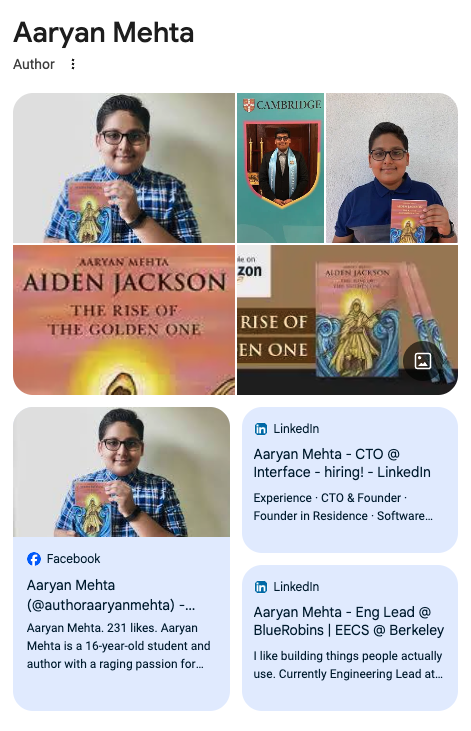
Google has decided that I am an Author, and has selected, as its evidence, a thirteen-year-old.
And the genuinely unpleasant version of that thought is this. In my head, that book is the murder weapon. The single piece of me that is legible to anybody else is the one that cost me the rest of it.
I don’t have a redemptive ending for this. I’m not going to claim I’ve made peace with the trade, because I haven’t. But I would make it again, because the alternative was that nobody would ever have known those characters existed at all – and eventually, inevitably, that would have included me.
That is the thing about my archive of writings that took me far too long to notice. Keeping everything unfinished does keep it alive. It keeps it alive in a room that nobody, myself very much included, ever walks into. I have now run both experiments at length. Publishing cost me a cast of characters I’d had since I was seven. Not publishing has cost me every year since.
So: this. Whatever this is. Nobody is grading it, there’s no canon for it to contradict, and no sequel is going to come along in two years and discover that the rules don’t hold. But it does have the one property I have been very carefully avoiding since the eighth grade, which is that once it’s up, it’s up, and it’s fixed, and it has my name on it.
There is a bet buried in here that I can’t verify yet. Those characters died because I finished them, and I am not at all sure that a person can be finished the same way. I keep changing, which means anything true I write about myself expires more or less on its own; next year I’ll disagree with half of this, and the disagreement will simply be the next thing I write. Maybe that makes essays safe in a way that fiction never was for me. Maybe I just haven’t found the price yet.
Either way. They were my entire childhood, and now they are names on a page. I’d like there to be more evidence of me than that.
-
This is not a small claim about Optimus Prime, by the way. Across roughly forty years of cartoons, comics, and films, the man’s defining character trait is that he will die for you and then usually come back to do it again. Making him a shopkeeper was, in hindsight, a fairly aggressive editorial decision. ↩
-
For anyone who didn’t grow up in one: a “society” is what a gated residential complex is called in India – a handful of buildings behind a wall, a watchman at the gate, some scrappy common ground in the middle, and, if you’re lucky, enough paved road to ride a bicycle on. The wall is the whole reason this story happened. ↩
-
In hindsight, naming your first and most powerful character “EveryOne” is the sort of thematically overloaded decision that a creative writing professor would circle in red ink and write “ON THE NOSE?” next to. At the time I simply thought it sounded extremely cool. ↩
-
I want to stress that I had no idea this activity had a name. I was not “writing fanfiction,” a term I would not run into for several more years. I was, in my own understanding at the time, just borrowing some good names off of people who appeared to be finished using them. ↩
-
India’s first national lockdown was announced with about four hours of notice and confined roughly 1.4 billion people to their homes. For a thirteen-year-old, the practical translation was that the gate closed and nobody could tell you when it was opening again. ↩
-
The mechanics of how a thirteen-year-old ends up with a real ISBN are much less romantic than the phrase “published author” suggests, and involve a free Amazon self-publishing portal and filling out a lot of forms. The printing process was slightly more interesting though – I learned to use Adobe InDesign from scratch, and somehow managed to give a small local printing press something that my enthusiastic parents gladly paid for to be printed. So now I have almost a thousand copies lying around of a book no one seems to want. Email me if you want to take one off my hands! ↩
-
“Canon” being the term for what is officially true inside a fictional world – what actually happened, how the rules work, who somebody is. It’s a word that mostly gets thrown around by fandoms arguing about films on the internet. It also happens to describe, with uncomfortable precision, the thing that ate my childhood. ↩
-
I should be honest that I don’t know exactly when this stopped being true, because it isn’t the sort of thing that announces itself. There was no afternoon where I noticed the silence. There was just a year somewhere in there where I was still riding and no longer arriving anywhere. ↩