The Cost of Efficiency
On trading the wide-eyed excitement of a kid who drew dragons for the quiet competence of someone who can finally build them — and going looking for the dragons again.
I don’t remember the last time I was truly excited for something.
I don’t mean small-scale excitement. The brief, caffeinated rush of adrenaline you get before a game-winning roll in Catan, or the frantic seconds Gradescope1 takes to load after a midterm notification hits your inbox. I’m talking about genuine, prolonged excitement. The kind that acts as a physical weight pulling you out of bed; a reason to exist in the first place. I mean the sort of fire that isn’t just a short-lived burst of emotion, but a heightened sense of purpose that vibrates deep in your core during every waking moment.
The thing is: even though I may not remember when specifically I was last excited for something, I know that I most definitely used to be excited about things a lot back in the day. My mind goes back to elementary school. At this young age, having observed my father’s work as a software engineer, I had made it my life’s goal, my true singular purpose, to one day master the same languages he used to command machines, to use them to take my ideas and bring them into reality. Having not yet learned these foreign-seeming scripts and syntaxes, however, I instead temporarily settled for dealing with the first part of that idea-to-reality pipeline — coming up with concepts and fantasies that I one day hoped to translate into applications on a phone or computer.
And I took this seriously, much more seriously than one would imagine an elementary schooler would take the quite grown-up and mundane-sounding task of product design. Just like any other child at the time, I was absolutely enamored by the (to me) newly popular medium of mobile video games. Games like Subway Surfers, Fruit Ninja, and Jetpack Joyride had me begging my mom for an extra 10 minutes of time on her iPhone 6. However, more than all of these, there was one particular game that I was absolutely obsessed with — Dragon City, a game all about breeding and fighting (you guessed it!) dragons. One of the many titles from the Facebook-to-mobile ‘game factories’ of the 2010s,2 Dragon City had my eight-year-old self trapped in a loop of breeding and leveling up a pixelated roster of reptiles.
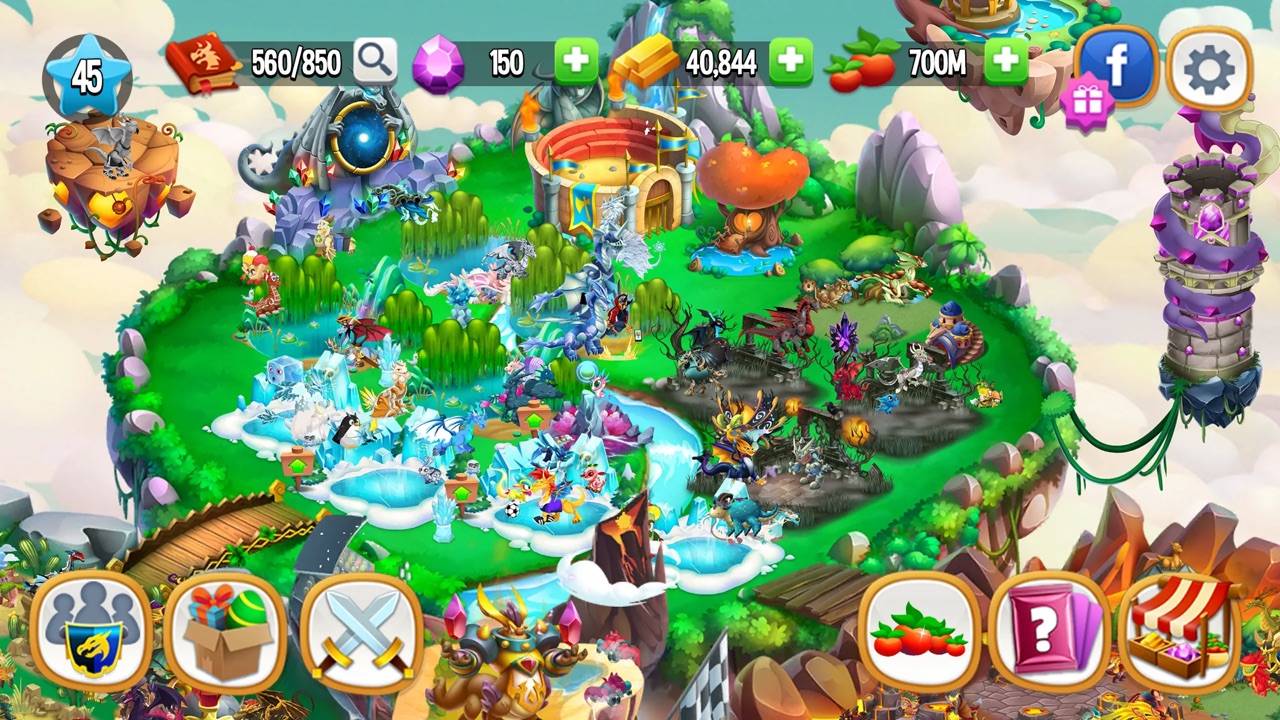
Dragon City, lifted straight from its Google Play store page. While formatting this post I went and searched it up, fully expecting a graveyard, and instead found the game alive and well in 2026, complete with a steady stream of Reddit threads still calling it a cash-grab a decade later. Some things are forever. Anyway, here’s a picture.
My obsession with this game combined with my interest in application design, and the next thing you knew it, the hours I had spent glued to my mom’s phone screen turned into hours spent holed up in my room with a notepad and a box of coloring pencils, furiously drawing and then crossing out screen layouts and writing out mechanics for my very own, dragon-themed game (look, I said I was motivated, not that I was creative. I’m sure that if you found and went through a lot of these scraps of paper, you’d find some pretty striking similarities between my designs and the designs of the game that had inspired them in the first place). I’d take these drawings to school, show them to all my friends, model playing out rounds of this game’s rudimentary combat system with them, and then spend more hours refining these mechanics at home just to go back and do it all over again the next day.
Yet, even though this process was incredibly repetitive, and despite my acute awareness that this game was most likely never going to be anything more than just some ideas in my head or on a few sheets of paper, I was genuinely excited to wake up every day and work on it. Every moment I spent not working on these designs, the thoughts of them floated around in the back of my head. I would be playing cricket outside with my friends when I’d randomly come up with an idea for a new dragon to add to the game, and I’d find myself sprinting home mid-game to jot down a rough sketch of its form and abilities before I forgot about them. This game (which I dubbed Dragomania3) became my life.
And even as I eventually grew out of drawing out game screens in my notepad, my excitement and fascination with the tasks I was working on followed me as I grew older. And actually, so did dragons! In early middle school, my friends and I started an “agency” called NoteArt, where we would draw these intricate designs and patterns onto the covers of our fellow classmates’ standard school-issued notebooks, in return for a small payment which we then put towards buying potted plants to donate to our school’s plant nursery. I once again spent every instant of my free time working on these designs, adding new patterns and elements to my ever-growing repertoire of motifs. But the crown jewel of my collection, the one design that I spent weeks on, was the NoteArt logo — a simplistic drawing of a dragon that I named “Note” (once again, really creative of me) that I would draw in the corner of every page that NoteArt ever customized for its so-called customers. I still remember every sharp edge and every curve of that design, the shade of teal I’d use for its wings, and the stylized font in which I would write the NoteArt name below every drawing of the dragon.
And this thread of obsession didn’t just stop at game design or notebook doodles. By early high school, my creative outlet had shifted from the visual to the verbal; I spent months painstakingly crafting a novel, pouring every ounce of my spare time into a world built of words. And yet, even in this new, more “mature” endeavor, I found myself returning to the same source of power. I made sure to give my main character his own dragon friend, on whose back he soared through the skies during one of the most important scenes in the plot line. I can feel the rush of that thrill — the way my fingers flew across the keyboard as I tried to capture the rush of the wind and the sheer, unadulterated freedom of flight. It was the same feeling I had in that cricket field years prior, the same spark that kept me awake under my covers with a metallic gel pen in my NoteArt days.

The novel in question, which somehow ended up real enough to have a cover and sit on Amazon. The dragon shows up about two-thirds of the way in, exactly where you’d expect a teenager to put one.
But somewhere between that manuscript and the present day, the dragons stopped showing up as often. As I finally began to master the “scripts and syntaxes” my father used, the world became less about the what and more about the how. The “heightened sense of purpose” I felt while creating slowly made room for a series of high-stakes, “small-scale” stresses. I started thinking less about what would be cool and more about what would be efficient. My sense of accomplishment shifted from the internal joy of finishing a dragon’s wing to the external relief of seeing “All Public Tests Passed” show up on my Gradescope assignment page. Somewhere along the way, I started taking my goals so seriously that I sometimes forgot to actually enjoy the pursuit of them.
The truth is, I have the tools now that my eight-year-old self would have killed for. I can speak to the machines. I can build the reality. But lately I’ve leaned on the steady competence of the technician far more than the wide-eyed excitement of the dreamer. Most days I’m not sprinting home to jot down a sketch; I’m walking to class, checking my emails, and waiting for the next midterm score to tell me how to feel.
It is a strange sort of nostalgia, missing a version of yourself that’s still technically here. I have the hands that drew those wings; I have the mind that built those worlds; I finally have the “scripts and syntaxes” I once thought were the keys to the kingdom. But the kingdom itself has gone quiet. The dragons didn’t die in a flash of fire or a dramatic exit; they just slowly thinned out, becoming more transparent with every class I took and every line of efficient (gotta love a function that runs in O(1)4) code I wrote, until some days I could see right through them to the plain reality of a career path.
I used to think that the tragedy of growing up was losing your tools to be creative and excited, you know? The time, the crayons, the imagination. But I think the trickier version is having the tools and forgetting, for a while, what you wanted to build with them. I can speak to the machines now, more fluently than I ever dreamed. The harder part is remembering I have things I actually want to say to them.
Lately, though, I’ve been trying to read that forgetting less as a verdict and more as something I can do something about. The quiet bothers me, and I think the fact that it bothers me is a good sign. You don’t get annoyed at an empty sky unless some part of you still wants something to be flying around up there.
And the more I think about it, this “essay”5 is probably the closest I’ve gotten to the old feeling in a while. Nobody assigned it. There’s no test to pass, no big green checkbox waiting at the end to tell me I did the right thing. I wrote it because I wanted to, which is the same reason I used to fill notepads with dragons.
So, I’m here. I’m capable. I’m a builder. The sky’s a lot quieter than it was when I was eight, and most days I’m still just walking to class. But the other night I caught myself sprinting home to write this down. I’d forgotten I still did that.
-
For anyone who hasn’t suffered through a CS class: Gradescope is the autograder that most of my assignments run on. You submit your code, it runs a battery of (both hidden and public) tests, and a few seconds later it decides how your evening is going to go. ↩
-
A whole genre of the early 2010s: studios that spun up dozens of “breed-and-battle” or “build-and-wait” titles on Facebook and then ported them to mobile, all running on roughly the same loop of timers and soft currency. As a kid I just thought they were magic. In hindsight they were extremely well-tuned Skinner boxes, which, honestly, respect. ↩
-
Naming a dragon game “Dragomania” is the kind of branding decision you can only make at eight. I stand by it completely. ↩
-
O(1) means “constant time” — the operation takes the same amount of time no matter how big the input gets. It’s the gold standard of efficiency, and there is a genuinely satisfying little hit of dopamine when you manage to get something down to it. That hit is real; it’s just a different shape than the one I’m writing about here. ↩
-
If you can even call it that. The word “essay” has always messed with me just a little. It implies an assignment to complete, a structure to follow. Most importantly, however, it’s always felt to me like it implies some kind of pending trial: a judgmental teacher reading through it, leaving red ink in the margins and a number at the top to tell me how I did. This has none of that. Nobody’s grading it, there’s no rubric, and the only person deciding whether it was worth writing is me. Which, now that I type it out, is sort of the entire point. ↩